Merry Christmas from the Sonot Kkaazoot organizers

Although Christmas is predicted to be somewhat chilly in the Fairbanks area, we hope that you will still find time to enjoy the holidays skiing with family and friends. Remember that the Ski Your Age event is happening this Saturday, 28 December starting at 10 a.m. at the Birch Hill Recreation Area.

Everyone has previous “work” experiences that fail to show up in professional resumes or curriculum vitae. In the spirit of the holiday, the Sonot organizers (aka the SCUM) share memories of their brief tenure as “tiny reindeer” for the Nordic Ski Club of Fairbanks (NSCF) Candy Cane event. After several young skiers were heard telling their parents that we “weren’t real reindeer,” the SCUM were forced back into reindeer retirement. Here’s why (photos by Dermot Cole and Mom):

Bob & Dan sm red beard reindeer sm Tiny reindeer smIMG00332SantaSantawithkids

However, here’s hoping that Santa with real reindeer visits your homes tonight, and that you have an opportunity to enjoy this really special time of the year outdoors.

http://www.alaskadispatch.com/article/20131220/winter-daylight-lights-landscape-setting-sun

Merry Christmas (and happy birthday to NSCF co-President Pat Reinhard)!

Random Sonot Kkaazoot scenes from 2004 to 2011

Image

Photos from various SCUM and SCUM spouses

More Sonot Kkaazoot training opportunities

Saturday, 28 December 2013 is the 10th annual Ski Your Age (in kilometers) event and a great opportunity to burn off some of those extra holiday kcal that will be consumed. Right now the long-range forecast calls for warmer weather conditions  than those faced by Distance Race #1 participants. The Ski Your Age event is not a race but rather an opportunity to share leftovers and our wonderful Birch Hill trails with all your visiting friends and family members. There is no entry fee for the Ski Your Age but the event is a fundraiser for Fairbanks Cross-Country (FXC), the junior race program of the Nordic Ski Club of Fairbanks. Friends of FXC organize the event that officially runs from 10 a.m. to 4 p.m. with sign-up and food in the Birch Hill Cross-Country Ski Center (large new building).

On the following Saturday, 4 January 2014, the Buetow Dental Distance Race #2 will be held starting at 11 a.m. This race will be classical technique and gives participants the choice of 10 or 20 km distances. Raven Cross-Country provides door prizes to race participants whose names are drawn during the event. This is a good way to start off the New Year.

First Distance Race is Saturday, 14 December 2013

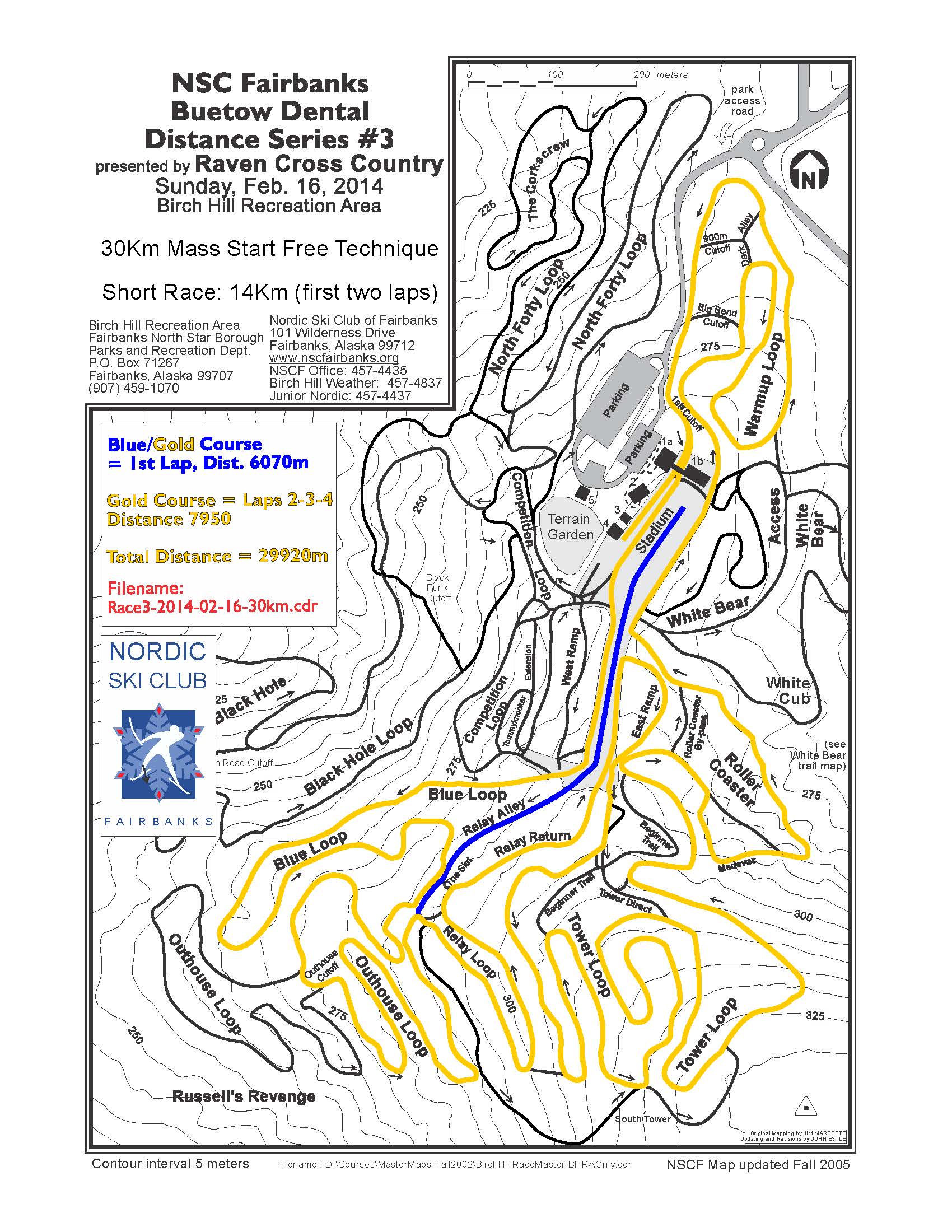
The first of the Buetow Dental Distance Series races presented by Raven Cross Country (thank you, Fred Raymond) will be held at Birch Hill Recreation Area this Saturday, at 11 a.m. The 7.5/15 km race is freestyle. Sign up for all the Distance Races and the Sonot Kkaazoot and save on registration costs. The Distance Races provide an excellent opportunity to ramp up toward the 40 and 50 km Sonot Kkaazoot.

In spite the second major wind storm of the season, the trail groomers will make sure that the course is awesome by race time. 

Have you made your donation to the Birch Hill Trails fund yet? Here’s the link to do so online: http://www.nscfairbanks.org/index.php/trails/519-great-grooming-costs-money-donate-to-nscf-trails-now). Without donations to pay for equipment, fuel, and trained operators, grooming that leads to our fantastic trail conditions will need to be cut back. 

Hope to see you on the trails soon.

Mat-Su Icicle Double

For those Sonot Kkaazoot skiers who have a day (or night) job in addition to training, the holidays are a great opportunity to ramp up the skiing volume. However, variety is important, and challenging yourself on new trails keeps skiing fun.

Here’s an option to consider after skiing your age in kilometers on 26 December: drive down to Hatcher Pass, and ski the Mat-Su Icicle Double, 2.5 to 30 km classical on Saturday, 28 December followed by 2.5 to 30 km freestyle on Sunday, 29 December. With five different distances both days, your entire family could participate. Kids who are 13 years old or younger can enter free if one of their parents skis, too. All participants get a t-shirt, but if you finish the 30 km ski both days, you’ll get a pint-size beverage glass with the Mat-Su Icicle Double logo. There’s no mention of what beverage they’ll supply at the finish to utilize your new pint-size glass.

Here’s the link to the event information:

http://www.matsuski.org/competition/mat-suicicledoubleatwo-dayeventdecember28and2911am

or contact Dave Musgrave for further details at: fbksdave@gmail.com

This would be a fun way to close out 2013 on a high note.

Long Distance (a book review by Robert Hannon)

Editor’s note: soon this warm, brown October will become a new data point in the Fairbanks weather record books, and we’ll be able to start on-snow training for the 2014 Sonot Kkaazoot. In the meantime, this book report by Robert Hannon reminds us that training for a long distance event requires learning to deal with whatever Mother Nature throws at us.

Robert at the finish line of the 2013 Sonot Kkaazoot

Robert at the finish line of the 2013 Sonot Kkaazoot

When I fell in with the ski training group known as the SCUM (Susan’s Class of Uncoachable Men, the current Sonot organizers), I naturally assumed there would be skiing and training. I have not been disappointed here. When nature provides snow, SCUM can pretty much be found out on it most hours of the day or night, even though we only meet officially once a week. Indeed, even in the protracted snow drought this fall SCUM were still out on roller skis, ski walking or running along trails in lieu of skiing. Also, Mother SCUM periodically emails us with links to training videos from Sweden and exhorts us to remember our core exercises.

What I wasn’t prepared for was a reading assignment. Now, I’m as literate as the next person. I glance at microwave instructions on frozen meal cartons, scan the urgent stickers on junk mail, and peer at road construction notices when driving. But you could have knocked me over with a heat gun set on low when Susan handed me a book this summer and told me it would help my skiing. I didn’t get what she meant at first.

The book was Bill McKibben’s Long Distance. McKibben’s name might be familiar to some through his efforts to document the steady rise of global temperatures and the reasons for and consequences of that rise. Long Distance is a more personal book. Like Dante before him, McKibben finds himself a bit lost in mid-life. He writes when he turned 38 he felt the limitations of age edging closer. Being a XC skier, he decided to give himself over for a whole year to train with single-minded intention and see where that took him. He secured the services of a professional coach and diligently followed his training plan.

Long Distance then is our ticket to follow the competent amateur McKibben as he works out, races and explores the world of professional Nordic skiing. He’s a wonderful guide. His style is funny, self-effacing but full of interesting bits of information. He also paints vivid scenes. One example: early in the book McKibben confronts a dramatic shift in weather on race day. Panicked by the bewildering alchemy of waxing, he scurries from trailer to trailer seeking advice from team crews who view him and his questions with darkest suspicion and mumble vague suggestions. You might as well ask an experienced Alaskan angler where the best place to fish lies.

Along the way, McKibben also puts XC skiing in the larger landscape of American professional sports coverage and why even during Winter Olympics our sport of choice barely rises into broadcasters’ awareness.  We hear from Swix and Fischer salespeople about the trials of marketing Nordic skiing in the U.S. Not content to leave it at that, McKibben compares our national indifference with the near mania Scandinavians feel for all things Nordic. It is enough to make you weep. We also meet top skiers and coaches and get a sense of what it takes mentally as well as physically to excel as an athlete.

All these points have been covered before by other writers on other sports. Indeed, many of the observations could be found in the Nordic Skier newsletter or on the Fasterskier.com website. What elevates Long Distance above other efforts to document the “inside world” of sports is McKibben’s own story, more specifically his relationship to his father.

Half-way through his training year McKibben learns his relatively young father has been diagnosed with terminal brain cancer. Thus, Long Distance becomes an “inside look” at an American family as it strives to make sense and cope with disease and death. To his credit, McKibben handles these scenes without heavy sentimentality. Applying the same eye for detail he gives to waxing and training he recounts the physical, chemical and radiation therapies his father undergoes as he retreats step by step to the end. We also see the toll this medical slog takes on the family.

In this way, McKibben earns the right to draw some revealing parallels between his father’s ordeal and what McKibben has learned about distance ski training. What might be cheap clichés about his father running the good race and endurance, become genuine insights into the relationship between ordeal and character in an average American life.

By the end of Long Distance I came to see why Susan lent me the book. Not being athletically inclined until my later years, I continually find it revelatory that pushing one’s limits physically, even a little, pays off emotionally. Finding out how one meets pain and fatigue in a long distance race, when conditions suck but there is only one way forward and that is the finish line, instills a sense of confidence when other annoyances come your way at home or the work place.  “Well,” you can say to yourself, “at least it isn’t the 2013 Sonot!”

Anyway, I handed back Susan’s copy of Long Distance a little wiser and happy in the knowledge that my own copy was on the way from Amazon.  I know I’ll be reading it again.

Forecast calls for dryland training in Fairbanks through late October

The unseasonably warm October temperatures in much of Alaska are predicted to continue at least through the end of October. Although much of the government has been closed down for since 1 October, the National Weather Service, because of the “essential” nature of their work, has been issuing weather forecasts and warnings. Sadly, for cross country skiers, the forecasts aren’t encouraging. The figure below is today’s 8 to 14 day forecast, and you can see by the intense red over interior Alaska that any precipitation we’re likely to see, probably won’t be in the solid form.

814temp.new

Although you can stone grind and wax your skis in anticipation of the upcoming ski season, you probably should plan on dryland training for a couple of more weeks. If you can’t face ski walking, rollerskiing, or watching mold grow on your snow shovels, you could consider some ski-specific strength training that might help when winter finally comes to interior Alaska:

http://www.youtube.com/watch?v=jRXB5vEOmC8

Remember that the Sonot Kkaazoot will be held a week later than normal because of Arctic Winter Games, so you’ll be less behind on your on-snow Sonot Kkaazoot preparation than you might have been.

2013 Sonot Kkaazoot skiers on the Sonot connector and Chena River

Image

All photos by Sam Lamont

Special people who make the Sonot Kkaazoot possible

In the Fairbanks area, equinox is a time of rapid transition from light to dark and back again. It is also the time for our two marathon events, the Equinox Marathon (Ultramarathon, and Relay) held on the Saturday nearest the autumnal equinox, and the Sonot Kkaazoot held during the vernal equinox period. With the 51th Equinox Marathon successfully contested a little over a week ago, it’s time to start preparing for the 27th Sonot Kkaazoot.

For the first post for the 2014 Sonot Kkaazoot season, I wanted to focus not on the skiers who participate in the Sonot, but on the various race volunteers that make the event possible.

Because the Sonot Kkaazoot starts on the Chena River and then traverses on trails groomed just for this event, there are road crossings that needed to be staffed with volunteers who shovel snow over the road as cars pass by:FWW crossing team

and direct cars and skiers at three different locations:

Traffic controllers

Sun beam volunteer

Volunteer at her truck

Not only do cars present risks to Sonot skiers, at the Fort Wainwright ski hill, the racers need to be directed away from alpine skiers, snowboarders, and those on tubes:

FWW ski hill controllers

ski hill

And someone has to organize all these people (and supply them with nifty visible vests) and Sam Lamont did that task (and took all the photographs in this post):

Sam Lamont

Feed stations were staffed by local high school ski teams and their parents except for the finish line that Bob Wilkinson staffed in addition to his efforts organizing the feed stations and the cleaning up the jugs after the event:

Bob Wilkinson

Organizing the start/finish area and providing commentary throughout the day was Kent Karns:

Kent Karns

Dan Baker took on setting up the course and sweeping it after the race:

Dan Baker sweep

In between he took a lot of race photographs that should soon be available on his photography website:

http://www.retrospectionimage.com/

Timers for the Sonot Kkaazoot are on the Chena River from the first start to the last finish. Here are the two intrepid members of the timing crew still at work when the last racer finished:

Last Sonot timers

And then finally, there’s Bad Bob Baker, who worked with the 2013 Sonot organizers way more than he planned to make sure that the Sonot Kkaazoot continued beyond his tenure as race organizer:

Bad Bob

I hope that you’ll consider joining these volunteers for the 27th Sonot Kkaazoot on Saturday, 29 March 2014. Leave a comment and we’ll contact you.