Long Distance (a book review by Robert Hannon)

Editor’s note: soon this warm, brown October will become a new data point in the Fairbanks weather record books, and we’ll be able to start on-snow training for the 2014 Sonot Kkaazoot. In the meantime, this book report by Robert Hannon reminds us that training for a long distance event requires learning to deal with whatever Mother Nature throws at us.
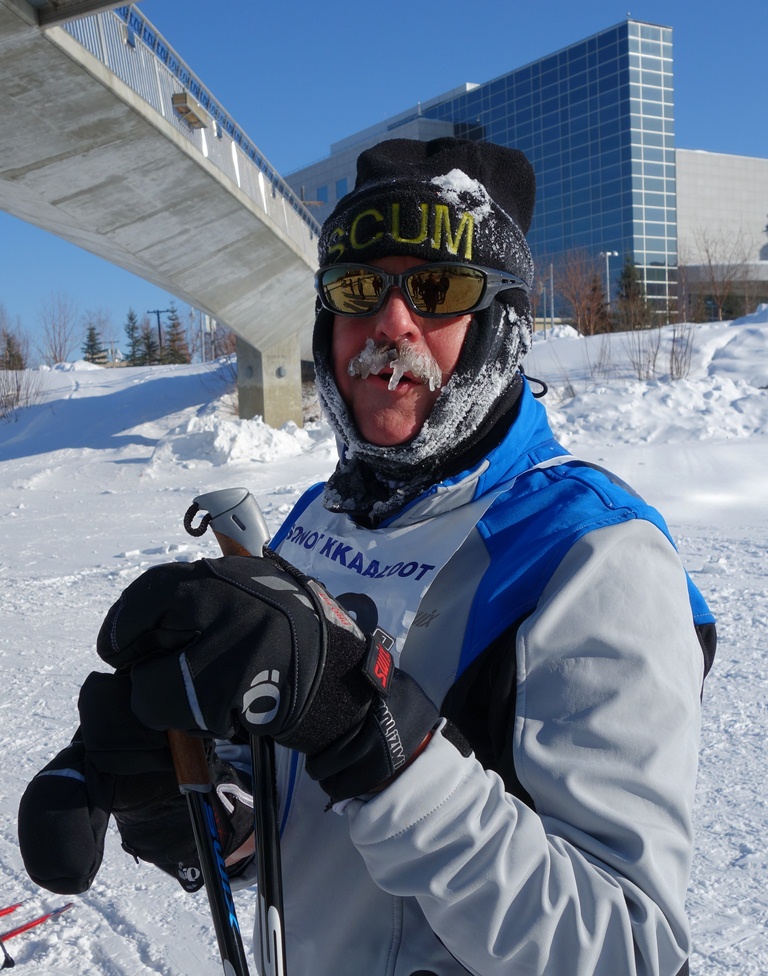
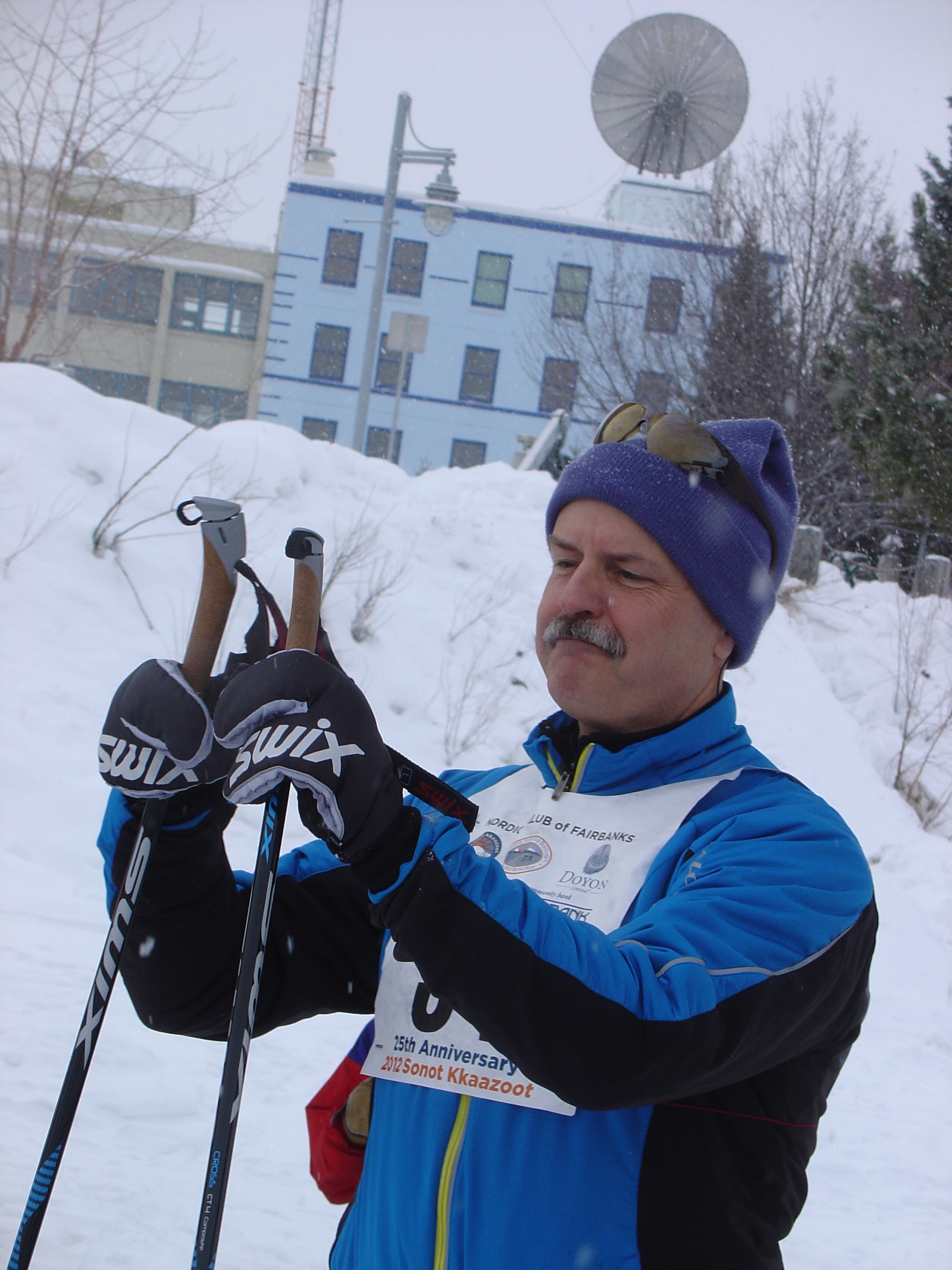
Robert at the finish line of the 2013 Sonot Kkaazoot

Robert at the finish line of the 2013 Sonot Kkaazoot

When I fell in with the ski training group known as the SCUM (Susan’s Class of Uncoachable Men, the current Sonot organizers), I naturally assumed there would be skiing and training. I have not been disappointed here. When nature provides snow, SCUM can pretty much be found out on it most hours of the day or night, even though we only meet officially once a week. Indeed, even in the protracted snow drought this fall SCUM were still out on roller skis, ski walking or running along trails in lieu of skiing. Also, Mother SCUM periodically emails us with links to training videos from Sweden and exhorts us to remember our core exercises.

What I wasn’t prepared for was a reading assignment. Now, I’m as literate as the next person. I glance at microwave instructions on frozen meal cartons, scan the urgent stickers on junk mail, and peer at road construction notices when driving. But you could have knocked me over with a heat gun set on low when Susan handed me a book this summer and told me it would help my skiing. I didn’t get what she meant at first.

The book was Bill McKibben’s Long Distance. McKibben’s name might be familiar to some through his efforts to document the steady rise of global temperatures and the reasons for and consequences of that rise. Long Distance is a more personal book. Like Dante before him, McKibben finds himself a bit lost in mid-life. He writes when he turned 38 he felt the limitations of age edging closer. Being a XC skier, he decided to give himself over for a whole year to train with single-minded intention and see where that took him. He secured the services of a professional coach and diligently followed his training plan.

Long Distance then is our ticket to follow the competent amateur McKibben as he works out, races and explores the world of professional Nordic skiing. He’s a wonderful guide. His style is funny, self-effacing but full of interesting bits of information. He also paints vivid scenes. One example: early in the book McKibben confronts a dramatic shift in weather on race day. Panicked by the bewildering alchemy of waxing, he scurries from trailer to trailer seeking advice from team crews who view him and his questions with darkest suspicion and mumble vague suggestions. You might as well ask an experienced Alaskan angler where the best place to fish lies.

Along the way, McKibben also puts XC skiing in the larger landscape of American professional sports coverage and why even during Winter Olympics our sport of choice barely rises into broadcasters’ awareness.  We hear from Swix and Fischer salespeople about the trials of marketing Nordic skiing in the U.S. Not content to leave it at that, McKibben compares our national indifference with the near mania Scandinavians feel for all things Nordic. It is enough to make you weep. We also meet top skiers and coaches and get a sense of what it takes mentally as well as physically to excel as an athlete.

All these points have been covered before by other writers on other sports. Indeed, many of the observations could be found in the Nordic Skier newsletter or on the Fasterskier.com website. What elevates Long Distance above other efforts to document the “inside world” of sports is McKibben’s own story, more specifically his relationship to his father.

Half-way through his training year McKibben learns his relatively young father has been diagnosed with terminal brain cancer. Thus, Long Distance becomes an “inside look” at an American family as it strives to make sense and cope with disease and death. To his credit, McKibben handles these scenes without heavy sentimentality. Applying the same eye for detail he gives to waxing and training he recounts the physical, chemical and radiation therapies his father undergoes as he retreats step by step to the end. We also see the toll this medical slog takes on the family.

In this way, McKibben earns the right to draw some revealing parallels between his father’s ordeal and what McKibben has learned about distance ski training. What might be cheap clichés about his father running the good race and endurance, become genuine insights into the relationship between ordeal and character in an average American life.

By the end of Long Distance I came to see why Susan lent me the book. Not being athletically inclined until my later years, I continually find it revelatory that pushing one’s limits physically, even a little, pays off emotionally. Finding out how one meets pain and fatigue in a long distance race, when conditions suck but there is only one way forward and that is the finish line, instills a sense of confidence when other annoyances come your way at home or the work place.  “Well,” you can say to yourself, “at least it isn’t the 2013 Sonot!”

Anyway, I handed back Susan’s copy of Long Distance a little wiser and happy in the knowledge that my own copy was on the way from Amazon.  I know I’ll be reading it again.
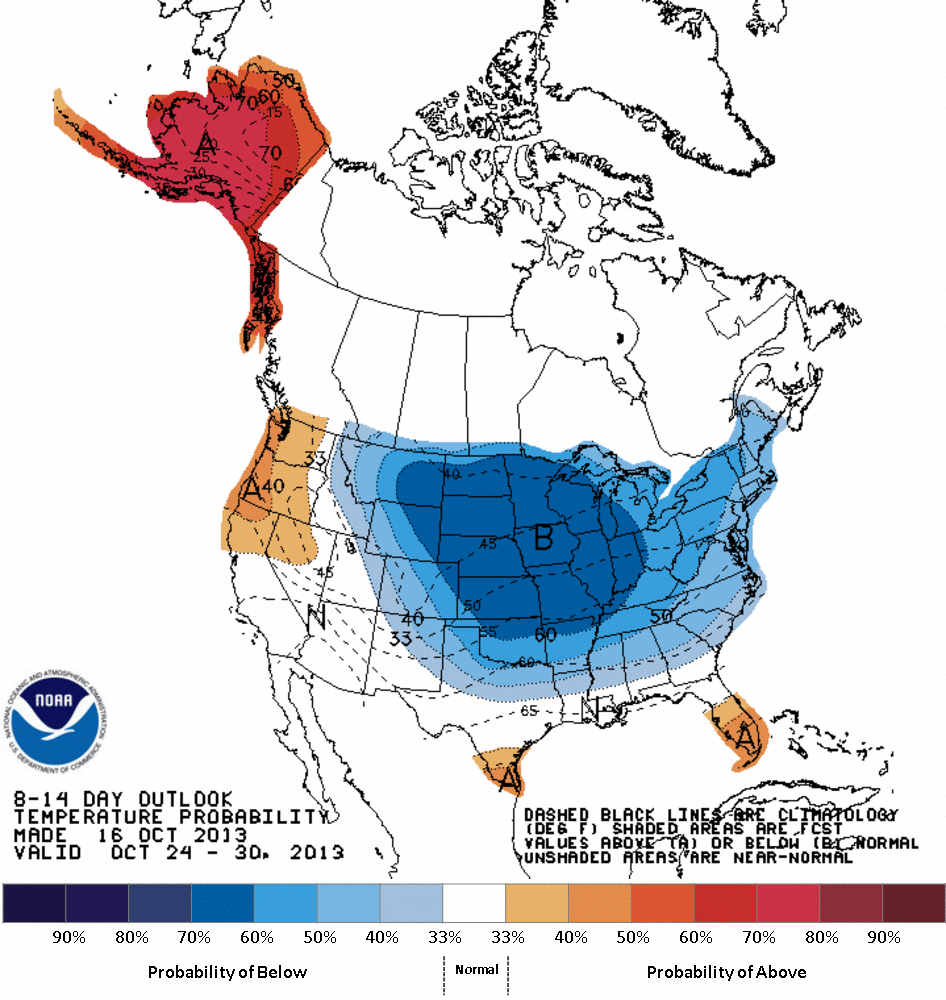
Forecast calls for dryland training in Fairbanks through late October

The unseasonably warm October temperatures in much of Alaska are predicted to continue at least through the end of October. Although much of the government has been closed down for since 1 October, the National Weather Service, because of the “essential” nature of their work, has been issuing weather forecasts and warnings. Sadly, for cross country skiers, the forecasts aren’t encouraging. The figure below is today’s 8 to 14 day forecast, and you can see by the intense red over interior Alaska that any precipitation we’re likely to see, probably won’t be in the solid form.

814temp.new

Although you can stone grind and wax your skis in anticipation of the upcoming ski season, you probably should plan on dryland training for a couple of more weeks. If you can’t face ski walking, rollerskiing, or watching mold grow on your snow shovels, you could consider some ski-specific strength training that might help when winter finally comes to interior Alaska:

http://www.youtube.com/watch?v=jRXB5vEOmC8

Remember that the Sonot Kkaazoot will be held a week later than normal because of Arctic Winter Games, so you’ll be less behind on your on-snow Sonot Kkaazoot preparation than you might have been.

Sonot Kkaazoot training tip: Ski the Sonot Connector

Sonot connector

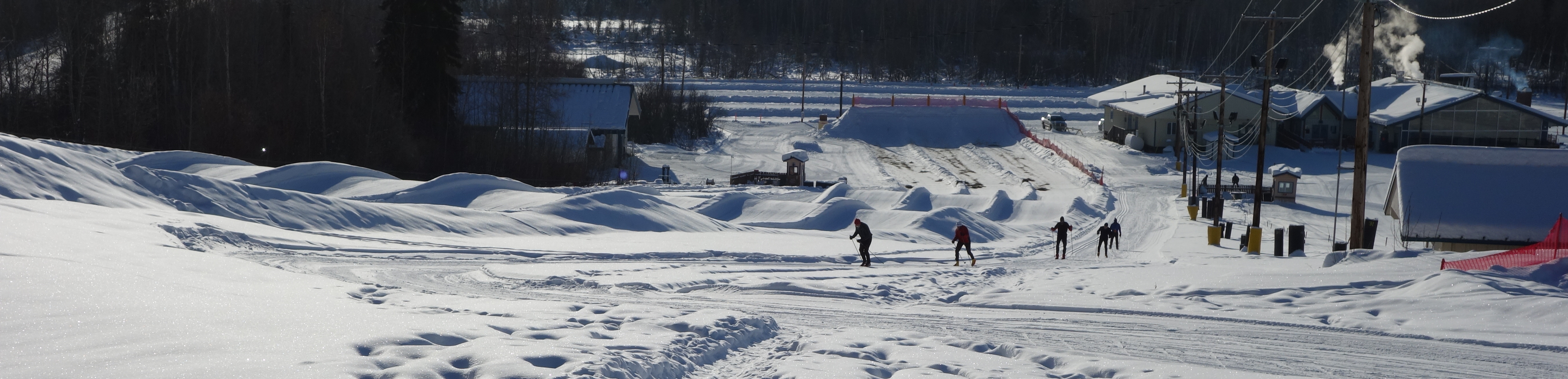
Where else can you ski a critical part of the Sonot Kkaazoot course, stop in at the Fort Wainwright ski lodge for a hot chocolate, and then ski back up the Sonot Connector to the White Bear? The 2 km Sonot Connector was added to the Sonot Kkaazoot in 2012 as an alternative to skiing up and down the alpine hill as was done 19 times during the Sonot Kkaazoot history. Four years, the Sonot was held entirely at Birch Hill (when the Chena River was deemed unsafe) and one year entirely on the river when the south facing trail that was unofficially the first Sonot Connector, melted to dirt. The new Sonot Connector is very user friendly as the climb/descent is broken up by a series of gentle switchbacks that are fun on the downhill traverse and offer much needed recovery on the uphill. The Fort Wainwright groomers maintain the Sonot Connector and all nordic skiers are welcome providing that they have a picture identification with them and stay on the groomed nordic trail. Take your wallet with you and enjoy a well-deserved snack at the ski lodge.

The Nordic Ski Club of Fairbanks is hosting a Wednesday night race on 13 March at 6:45 p.m. for those hard core skiers who want to race down and up the Sonot Connector from the biathlon range (http://wnrace.com/). However, for the less elite wave, incorporating a fun descent and a leisurely ascent in the southern exposure of this relatively new section of trails is worth a tour (or several) before the Sonot Kkaazoot.

The Grand Tour

“Start slow and go, go, go; start fast, and you won’t last”—advice from a wilderness adventure friend of Mike Ruckhaus

With the Sonot Kkaazoot just 40 days away, today’s unseasonably warm temperatures combined with having all the Birch Hill trails groomed within the past 48 hours made for absolutely awesome conditions for doing the “grand tour” of all the Birch Hill Recreation Area trails. This workout is a great pacing exercise as well as a dry run for nutrition and clothing needs for an extended ski effort.  Completing the “grand tour” of 26 km or the “mini-tour” of 16 km for skiers training for the 40 km Sonot is a fantastic confidence builder as well as an important element of one’s pre-Sonot training plan.

The black loops are the most demanding trails at Birch Hill and for good reason. They are technically the most difficult loops with short steep climbs, long continuous climbs, and technically challenging downhills. They are north facing and drop to the lowest regions of the park so are generally the coldest trails and are less frequently groomed than the more utilized lighted loops and White Bear trails. Also, unlike the Tour of Anchorage, where the challenging Spencer Loops are encountered at the very beginning of that 50 km race, in the Sonot Kkaazoot, a skier is in the midst of the Black Hole when the 25 km mark is passed.

To most effectively train for the Sonot, the “grand tour” should be skied in the order that trails are encountered in the Sonot. So today we skied the White Bear Access, White Bear, Moilanen Meadows, and Warm-up Loops that all 40 and 50 km Sonot participants ski, before skiing the Competition, North 40, Black Hole, Blue, and Outhouse loops that the 40 km skiers will by-pass (these loops according to my GPS total 9.91 km). Finishing off the tour involved skiing the Tower and Roller Coaster loops and around the main building to where we had started 3 hours and 23 minutes previously. The others had finished over an hour before the slowest of us, but two pieces of Eric Buetow’s birthday cake were awaiting our finish.

Thanks to my gizmo (as one SCUM called it), I had more than just a good feeling after this workout but also data to download.  With an overall average heart rate of only 129 (79% of my max), I know that I can ski faster without “blowing up.” The 9.91 km that the 40 km skiers will not ski took us 1:25:47, which works out to a pace of 8:40 min/km. By comparison, we skied the 11.05 km from the Sonot cutoff on the White Bear to Moilanen Meadows, the rest of White Bear and White Bear Access, and the Warm-up at a 7:42 pace, and we finished the Tower and Roller Coasters at a 6:39 pace when we could see the finish line. Heading for the warm-up hut for dry clothes and birthday cake, we started  replacing the 1882 kcal that we’d burned while skiing the “grand tour.”

Just 8 weeks until the Sonot Kkaazoot

With just two months until the start of the Sonot Kkaazoot, it is definitely time to start increasing both the intensity and duration of your ski workouts. This can be a challenging time of the year because the Birch Hill venue will be busy with Besh Cups, high school regional races, Town Races, and Junior Nationals between now and the start gun of the Sonot Kkaazoot. It may take a little more creativity and flexibility to squeeze in those longer and more intense workouts when the weather doesn’t cooperate. However, just because it is -37 deg F at Birch Hill on Sunday when you normally do your long overdistance workout doesn’t mean you have to resort to the couch like one of our AWOL SCUM:

IMG_0539

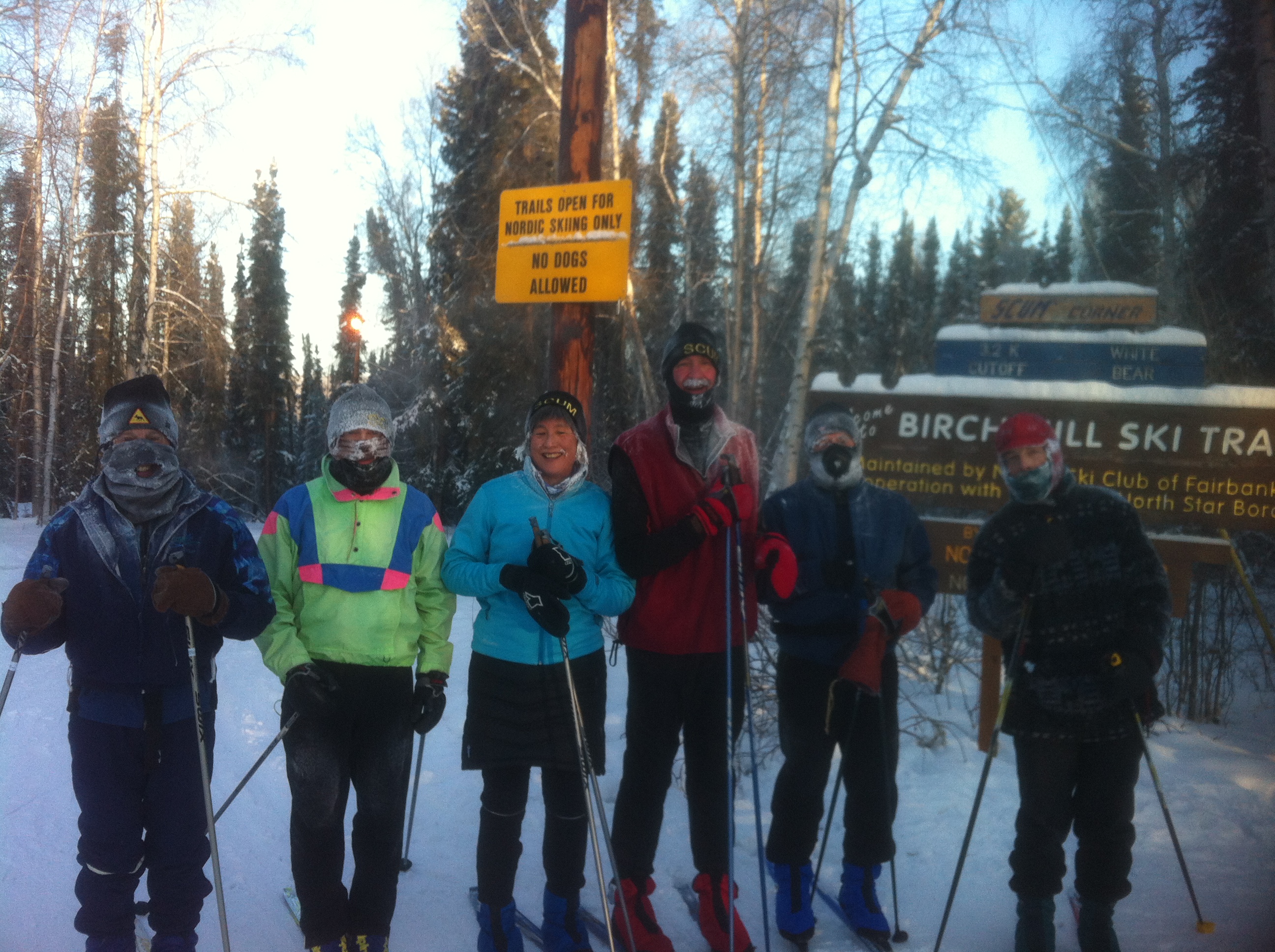
Layers of clothing may render a skier less fashionable than lycra speedsuits, but who is going to recognize you on the trail under these conditions?

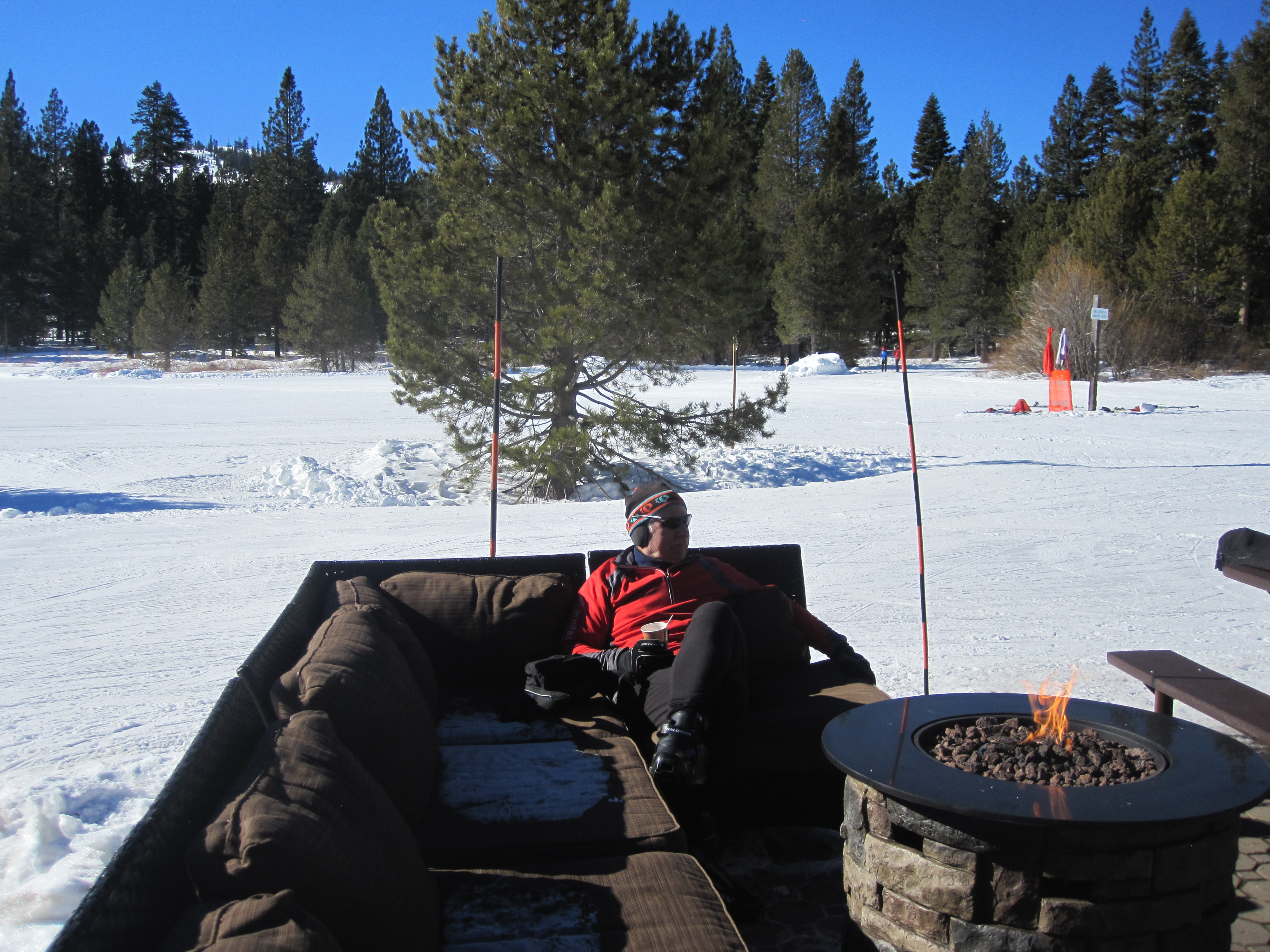
-37 deg F Dermot-37deg F SCUMWe have ample snow so get out and enjoy it. No excuses. On Sunday, these skiers had the Birch Hill trails virtually to themselves (only Bad Bob Baker lapped them twice). One of the skiers above has had 11 orthopedic surgeries and was still out there. Another of the frosty guys above had major back surgery last winter. Another skier owns a bar where late weekend nights are the norm–hardly, the occupation that would be conducive to getting up on Sunday mornings to ski several hours–yet he does. Why? Because all these skiers feel so much better skiing than not. Besides, the Sonot is only 8 weeks away. These aren’t young pups as all but one of the skiers in the bottom photograph is over 60 years old.

See you on the trails.

Photo from lower 48 courtesy of Carl (aka Thumper) Hemming, Birch Hill photos by Bill (Poles) Husby.

Advice for the first time Sonot Kkaazoot participant

by Robert Hannon

Photo by Margo Klass

A lot goes through your head waiting to start your first 50 K ski race. “How did I get here? What am I doing? Am I insane?” Those and many other questions prowled the darker recesses of my psyche as I stood under a light snowfall on the frozen Chena River last March at the Sonot Kkaazoot.

Take it from a man who loathed skiing two years ago. There are ways of avoiding this fate.  I offer you a few pointers as a public service for those contemplating entering their first long distance race.

Beware Strangers

I would never have found myself on the river last year if I hadn’t met a sequence of people.

The Kindly Enthusiast:

Every year my wife Julie and I are invited to a large caroling party. While Julie has a lovely voice mine is like a badly trained terrier, likely to wander off, heedless of commands.  My strategy is to stand next to the strongest singer and mime the words. But two years ago I decided it might be better to just sample the Christmas punch and rest my eyes lying down on a distant couch. When I reached the couch though I found someone else had reached it first.

Judging by outward appearances, Bill Husby seems harmless.  He certainly welcomed me cheerily, shifting to make room, and once I settled in we engaged in some polite small talk. It turned out he helped groom the ski trails at Birch Hill. Moreover, it seemed he would then go for a ski after the grooming.

“What, you mean after every grooming?”  I was stupefied.

With a deferential nod he agreed he did.

I was sure I was sitting with one of those crazed, if harmless, people who stand on street corners with placards announcing the Mayan Apocalypse. Yet, there was something infectious about Bill’s enthusiasm for skiing, so I stayed and chatted with him until our wives collected us.

It took several days before I realized Bill wasn’t so benign. Beneath his genial façade lurked the Nordic skiing equivalent of Typhoid Mary. I began slowly to entertain the bizarre thought there might be something to this cross-country skiing. Maybe taking a class in it was worth the money.

The Kindly Instructor:

That was how I found myself a month later in a ski class. It only took the instructor a few classes to spot my problems and show me what to work on.  It took a few more classes for me to fall in love with skiing. It was a revelation. I was St. Paul on the road to Damascus in some Scandinavian Bible.  Instead of tumbling from a horse though, I stayed upright on skis. More than upright, I was kicking and gliding towards Damascus and a voice was saying to me in a Norwegian accent, “Why did you persecute me?”

The Kindly Ski Group

It was a different man who greeted Bill Husby at the next Christmas caroling party.  With soda water in hand I planted myself on the sofa regaling him with my new-found passion.   When I had finally finished Bill innocently asked whether I heard of the SCUM.  He explained the name stood for Susan’s Class of Uncoachable Men. He said they met, more or less casually, on Sunday mornings at Birch Hill to ski and pick up pointers.

Well, I thought, he wasn’t wrong about skiing. It must be a safe group to join.

I was new to Birch Hill when I joined the SCUM the next Sunday. After a jovial introduction to those assembled in the hut, Bill casually announced, “We’re going to do the Blacks, the Blue and the Outhouse today.”

The names should have alerted me.  I spent the next couple of hours screaming as I plummeted down abysses or panting as I slowly herringboned my way back. Luckily the SCUM, like the Army, leaves no one behind.  I finally returned to the ski hut, dazed and exhausted. Bill handed me a cup of coffee.  “See, that wasn’t so bad!”

Oddly, he was right.  While I sat clutching the coffee mug and muttering to myself “Black Hole, Black Hole,” another part of me felt an odd glow of accomplishment. Maybe it was something the SCUM put in their coffee, but I found myself looking forward to the next week. Unlike my earlier expeditions with Julie, I had some technique to fall back on as I hurtled whimpering down a hill.

The Kindly Coach

Also, there is Susan Sugai, affectionately known as Mother SCUM. In the coming weeks she offered pointers on wax, on technique, on training, always pushing me a little past my comfort zone, always willing to answer a question. She explained part of SCUM etiquette included entering races and supporting trail maintenance.

The Moral of the Tale

It turns out the Sonot Kkaazoot wasn’t that bad.  Skiing folks are kindly. For the first 10 km, intentionally or not, Susan acted as a sort of wingman shepherding me along the Chena and into the hills, setting up an easy rhythm for the ski. Once we reached White Bear, she dipped her wings in farewell and engaged her after burners. I never saw her again, but by that time I was fine. Six hours after starting the race I crossed the finish line. Remarkably, I could still move my major muscle groups; I knew my name, where I lived and I could drive myself home. I may have even whistled a tune or two as I thought about the next year’s race.

Training ideas for novice Sonot Kkaazoot participants

For the first time Sonot Kkaazoot participant in Fairbanks, there are classes and training groups to assist you. Kristen Bartecchi Rozell instructs a Sonot preparation class as part of the Nordic Ski Club of Fairbanks spring series of adult lessons (admin@nscfairbanks.com). Chris Broda (broda@acsalaska.net) meets twice weekly with the Ladies of Leisure (LOL) group, and Susan’s Class of Uncoachable Men (SCUM) meets on Sunday mornings (rhannon54@yahoo.com).

If the weather is too cold, too snowy, too warm, or whatever, there are alternative means of training that will assist your Sonot Kkaazoot performances (and how you feel the day after). Susan Faulkner (shf@alaska.net) is instructing Pilates courses at North Star Ballet, and Denise Jerome teaches core strength as part of the UAF Student Recreation Center group fitness classes (http://www.uaf.edu/draw/src/fitness-classes/) that will strengthen your critical core muscles. Several SCUM (slamont@alaska.net) have become devoted advocates of the Elite Urban Bootcamp sessions (http://www.eliteurbanfitness.com/about-us) for cross training when skiers are time-limited but need to keep up their strength and endurance efforts. Erica Caroll teaches yoga for cross training and stretching out all those tight muscles from skiing at Infinite Yoga of Alaska (http://www.infiniteyogaofak.com/wordpress/).